The House of Marley Get Up Stand Up
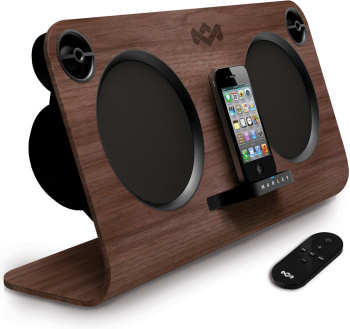
iPod docks are ten-a-penny now. What many of these products lack though is great, original design. And lets face it Apple's products are all about design. The iPod wasn't successful because it was a music player. It was successful because it wrapped all that clever technology up in a must have design. The House of Marley have stepped up to the mark with an original design that won't put your iPod/iPhone to shame!
The House of Marley "Get Up Stand Up" minimises plastic and brings wood back to the fore in home hi-fi design. The design is based around a curved birch wood panel with a walnut finish into which are set two each of 11.4cm woofers and 2.5cm tweeters which are backed with a decent power amp. The wood itself is sourced from sustainable sources (Forest Stewardship Council)
"We thought back to how people used to admire the large floor speakers back in the 1970s and 80s and how those speakers were design elements in the home..." said Rohan Marley, on behalf of The House of Marley. I can remember back to those times and yes - we used to put speakers on stands - making them part of the furniture.
Like many produces this system also has a 3.5mm jack so you can use other audio sources, but this is very much aimed at the Apple audience that want to show of that latest iPhone 5 they rushed out to buy!
The MARLEY "Get Up Stand Up" is available for purchase at HMV and other selected retailers for a RRP of £299.99:
Is your home nice and clean? Why?
OK - teenagers aside (and I have 2) we all like the idea of a clean home and many of us spend many hours at least trying to keep on top of the endless list of chores in this department. Why? Hygiene? The (hope) that you'll be more likely to find your keys in a tidy house?
No.
Now according to a piece of research by Kärcher, a company whose business is all about helping us get that sparkling finish. According to research conducted by this company our primary concern with having our house in a permanent stage of cleanliness is the fear that our neighbours (or other unexpected visitors I suspect) show up unannounced. 61% of participants in this study admitted to this fear of having our home on show in less than pristine condition.
I wonder how many others might admit to such a fear?
For those of us with limited funds and for whom a daily cleaner is not an option achieving a clean home is a chore. Many chores actually. Kärcher's research helps identify the most irritating with window cleaning, dusting, washing up being the three most annoying.
While this is all very interesting, Kärcher have not of course conducted this study simply to get headlines - as a producer of cleaning products they'd like to help us prepare for guests! In this case they want to tackle the top of the irritating list - window cleaning. This is so annoying and so difficult to get a good result that many of us only clean our windows every six months while others delegating this chore to a window cleaner.
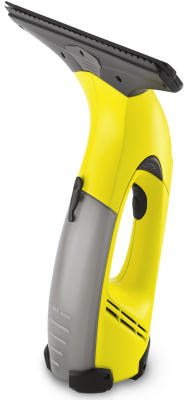
Enter the Kärcher Window Vac - a combination of Li-Ion powered hand-held vacuum and squeegy. Wipe over your windows with a wet cloth then use the vac to remove all the moisture avoiding those annoying streaks you get when you leave a wet window to dry naturally.
Weight could be a problem here, especially if you have a lot of windows such as a conservatory to clean and so Kärcher have kept this to a minimum weighing in at only 700g while maintaining enough power capacity to clean around 45 windows (this is based apparently on an "average" UK window size of 1m x 1.5m, which looking at my house seems fair).
If you'd like to know more than take a look on the Kärcher web site
Is the Raspberry Pi this generation's ZX80?
Listening to the Today Programme this morning it was interesting to hear the article on the launch of the Raspberry Pi, a tiny piece of circuitry aimed at getting people (children mainly) back into programming. How we ever, as a country, managed to loose this skill and interest is quite frankly beyond me.
My computing "career" started as a 14 year old visiting the local girls grammar school once a week with a couple of other "geeks" (a term yet to be coined) to use their teletype and 110 baud acoustic-coupler link to an ICL 1900 mainframe at Kent College. This was followed by writing Mastermind on a programmable calculator and eventually the arrival of my very own Sinclair ZX80 which, to my mothers surprise, arrived in a Jiffy bag! It's still in my loft.
Computers and computing were new, they were exciting and.... well actually they did absolutely nothing. Take a ZX80 out of a bag and plug it in and you have a system that does... well... nothing. Not a thing. You couldn't even buy software to run on it. And that was the key - they were exciting but anything you wanted them to do you did yourself. With each step forward there would be a real sense of achievement. Armed only with the ZX80, a circuit diagram, an ancient black and white TV set, a copy of the Z80 op-codes and time that should have been dedicated to O and A levels I had my very own version of Space Invaders.
My daughter recently went through the process of choosing her 'A' levels. Sixth Form has moved on and there is now a bewildering array of courses on offer and to offer these schools now club together in consortia. As one of the first year at my school to take Computer Science A level (we had no teachers and so the subject was gallantly taken on by the deputy head and a sociology teacher) you may well imagine my surprise to find none of the colleges now offer Computer Science as an A level subject. A surprise it seems that's shared by Google's Eric Schmidt who went so far as being "flabbergasted". Not one college. Despite one of the colleges being a science and technology specialist!
Where is this rambling going?
Oh yes - the Raspberry Pi. It should come as no surprise in the days of smart phones to find this tiny circuit board hosts a full blown computer. From the Arm processor, 1080p graphics driver, USB ports to the SD-card memory slot everything you'd find on a laptop is here.
The SD card slot provides the primary storage media and this has to hold your operating system plus anything else you want. Given the system has two USB sockets secondary storage could presumably be achieved through a USB hard-disk.
So what can you do with it? There's a nice video from Robert Mullins, co-founder of the Raspberry Pi foundation which demonstrates the system in operation. Basically he boots into a version of Linux (there are several flavours available that will run on the constrained hardware) and from there demonstrates an educational programming language which I presume is analogous to yesteryear's BASIC.
The big question is "will the Raspberry Pi encourage children to take up programming", which is it's primary goal? That's going to depend to a large extent on schools, on teachers driving their pupils enthusiasm. My own interest was sparked by a maths teacher and an after school maths club - not everything has to be part of the appalling National Curriculum and compulsion is general the enemy of enthusiasm!
One thing is certain - for the Raspberry Pi to succeed schools are going to have to encourage projects where there is not currently an off-the-shelf solution - why write Space Invaders when you can buy it for £10?
Decluttering with musicMagpie

Games, music, CDs! There's no shortage of them and many of us probably have more than we really need, especially if you're one of those people that like to get there hands on the latest entertainment at the earliest opportunity!
What do you do with all these products when you're finished? For many of us they very quickly become shelf-candy, gathering dust and looking very sorry for themselves! musicMagpie is one option for those that wish to declutter their shelves and make a few bob into the bargain.
musicMagpie started out with some software for your PC that would let you scan bar-codes of unwanted products with your web-cam and provide you with an easy to access marketplace. They've now made things even easier with an iPhone app - instead of finding your missing web-cam simply install the app on your iPhone and 'click' the bar code is scanned and you can watch the pennies and, hopefully, pounds start to accumulate.
You can download the iPhone app directly from the musicMagpie website where you'll also find full instructions on how you can use their service.
I've not tried it yet but when I get a moment I'll definitely be taking a long look at the dust gathering on the seldom played games stacked on my shelf. If you have used musicMagpie please do post your feedback below!
GEAR4 AirZone Series 1
The ability to stream music wirelessly around your house isn't new. I've reviewed a number of wireless speakers in the past that connect via Bluetooth to a suitable device and hey-presto - wireless.
Bluetooth has limitations though - basically the source of music needs to be in the same room as the speakers.
Apple are looking to make things easier with their AirPlay technology. Rather than use Bluetooth AirPlay instead piggybacks your WiFi network. All recent Apple products come with WiFi and as long as you've gone through the pain of configuring WiFi in your house you can make use of the system.
Apple's part in the puzzle is providing the music source - iPad, iPhone, iPod or Apple Mac laptop or desktop.
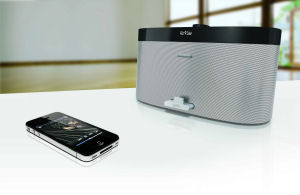
You'll need some speakers of course. GEAR4 have just launched their AirZone product. This can attach to AirPlay and you can beam your music directly to the speakers from anywhere within WiFi range.
For those of you that don't want to attach wirelessly (is there really a point if you're in the room with your iPod?) then there's a traditional iPad/iPhone/iPod dock, built in FM radio and a line-in socket allowing you to play other audio sources.
RRP is £199
Trying to save on petrol?
With fuel prices, around here at least, stubbornly stuck at their highest point in a very long time shopping around can save you a tidy sum over the year. Shopping around isn't easy though - you can easily eat up any saving through the extra miles you use - for the average car a 1p difference in price is only about 50p on a tank, or put another way if you're getting 40 miles per gallon, then drive more than 4 miles and you're out of pocket!
On several occasions I've driven to my local 'cheapest' garage (usually a local Asda) only to find on that day they are the same price as Tesco - two miles closer!
If you're away from home things are even more difficult because you don't know the local competition.
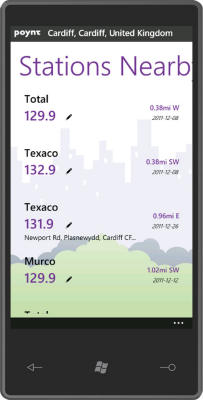
Poynt have teamed up with Whatgas.com to provide real-time dynamic petrol pricing information. When your tank is getting low simply check nearby prices and plan your journey accordingly!
The application runs on Apple iPhones, Blackberry's (tablet and phones) and Windows phones. The picture on the right is running on a Windows phone.
Need a TOUGH camera?
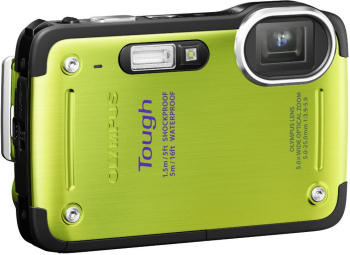
Actually most of us could probably do with something somewhat more rugged than many of the products on the market. Queue Olympus! This stalwart of the photographic industry has just launched the TOUGH TG-620 and TG-820 - which as well as being tough are available in a number of colours to match your wardrobe.
Both models boast a "shockproof, waterproof and freezeproof exterior" - I'm not sure why only the exterior - but I expect that suitably protects the internals as well. Given how cold it is here right now freezeproof seems a particularly attractive feature!
They also both provide a 12M pixel sensor - which is good enough for most personal photographic needs and supports full 1080p HD video capture for those that like to capture more than just a snap. If your hand isn't too steady the image stabaliser technology is also available in video mode.
The two models seem to be very similar with the 820 adding "more" : a stronger crush proof case, waterproof to a depth of 10m rather than 5m and 'drop-proof' from a height of 2m rather than 1.5m (for tall people?).
No viewfinder of course, as is standard these days with a 3" LCD screen displaying images and status.
Mio Cyclo 300 and 305 Bicycle SatNav products
Being a little lost in a car isn't usually a huge problem as long as the petrol gauge isn't hovering at, or just below, empty!
Being lost on a cycle though can be more of a problem, especially if you've been cycling all day and really just want to get home.
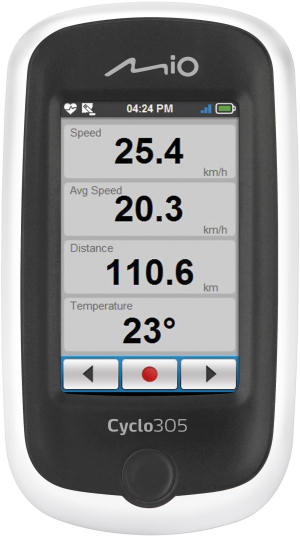
Sat-Nav on a cycle then makes a lot of sense, especially if you're out and about in unfamiliar territory.Mio Technology have just launched two SatNav devices targeted directly at the cyclists amongst us - the Mio Cyclo 300 and the Mio Cyclo 305. Out of the box these have maps installed and are ready to use.
Maps are just the start of what these devices can do however providing much more than just help when you're lost. When you've been travelling the country under peddle power there are a whole slew of stats that can give you that warm satisfied feeling that you've done your body good! The Mio Cycle products can not only tell you how far you've gone, how fast you went, how high you got (I'm assuming here that's altitude they mean!) it'll also tell you how many calories you burnt in the process.
The Mio Cyclo 305 adds to the 300 by including an ANT+ sensor that will connect with heart rate monitors and wheel sensors allowing additional accuracy.
Prices are as follows:
- RSP Mio Cyclo 300 with Regional Maps £249.00
- RSP Mio Cyclo 300 with Western-Europe Maps £299.00
- RSP Mio Cyclo 305 with Western-Europe Maps £349.99
They should be in the shops from April so do watch out for them!
New Year's Resolutions? How's your fitness promise going?
click to enlarge
It's almost the end of January already so maybe mentioning New Year's Resolutions seems a little late - many such promises are forogtten not long after the chimes that start the New Year!
One of the most common areas that we all promise ourselves are either to get fit or loose weight, or both! Did you promise to stick to the latest diet you heard about only to find it totally incompatible with living a hectic life?
A much better approach is to exercise - even moderately. Taking the stairs rather than the lift. Walking to the local shop rather than driving. Dusting down that bike you've had unused in the shed for the last five years!
How do you know how much exercise is enough? Did you brisk walk to the shop really balance out that rather yummy cream cake you found when you were there?
Gadgets - that's what you need. There must be a gadget that help you keep track of all that hard work and actually tell you when you've walked, run or climbed off those extra calories you couldn't resist.
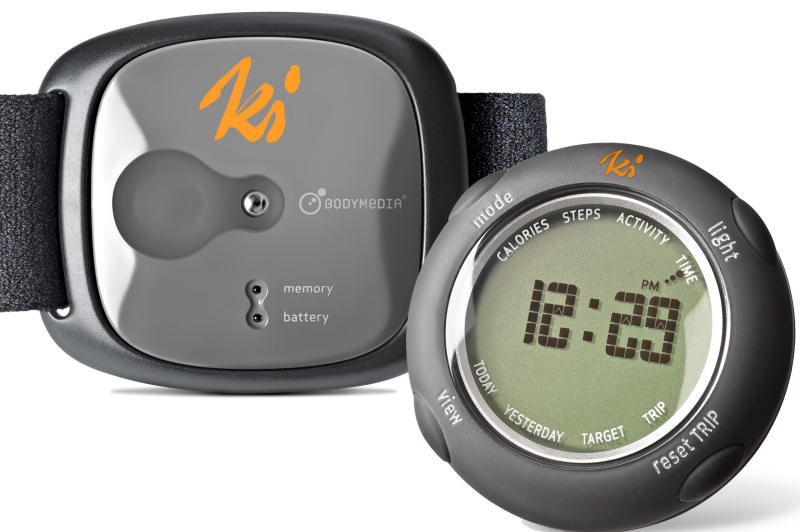
One of the latest gadgets to hit the market is the "Ki Fit". The main component is a special armband, which you keep on 24 hours a day - yes even when you're sleeping, although I suspect you may want to remove it for the shower! Packed with technical wizardry the armband continually measures what your body is doing, collecting an amazing 5,000 data readings per minute storing all that data in memory.
click to enlarge
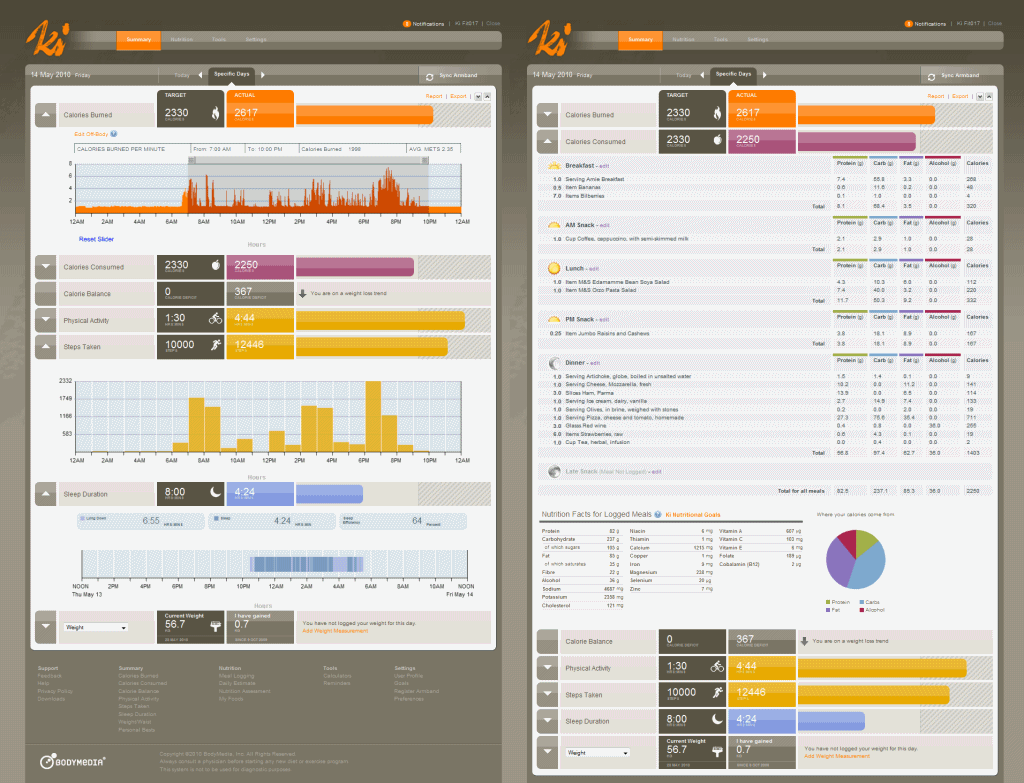
As well as measuring the usual things we all associate with fitness and weight loss, the Ki Fit also measures your sleep patterns - how long you slept and how good that sleep was. Huge amounts of research has gone into the importance of sleep showing longer sleep helping athletes performance and how sleep patterns affect weight loss. While we all recognise that sleep is important it's actually a very difficult thing to measure. Just how well did you sleep last night? Did your promises of an early night really come to fruition?
The Ki Fit monitors this for you along with standard metrics such as steps taken, level of physical activity and the resulting calorie burn. With this information you can start to understand how your body works and what works best for your body allowing you to potentially make some simple changes to your lifestyle that'll give more benefit than any number of faddy diets.
Of course having all this data locked in the armband isn't a huge amount of help, and simply knowing how many calories you've burnt doesn't help you compare that with the number you consumed. For this you import your data into a Ki Fit web-application which stores your data and lets you record an accurate food diary (no - the armband as clever as it is doesn't look over your shoulder and work out that you're currently devouring a cream eclaire!). The application is paid for on a subscription basis so you pay as you go.
While I don't particularly have a weight issue I do like to try and stay in shape and I suspect that having numbers to play with would be quite a boost to a fitness regime!
I've not had a chance to play with the Ki Fit but it does look like a very interesting development. If you have one please do leave some comments below and let us all know how well it has helped you stick to your resolutions!
There's more information on the Ki Performance web-site.
Flip Video..... RIP
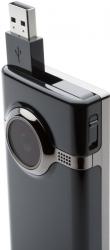
We've reviewed many of the innovative 'Flip' video family of products over the last few years. Pure Digital Technologies, the creative little company behind Flip, left all of the well established camera and video vendors playing catchup. Larger, slower, less innovative companies see the acquisition of these agile small start-ups as their way to 'catch-up'. Innovation by proxy as it were. This was the case with Pure Digital Technologies - although in this case rather than an established camera company the suitor was networking giant Cisco. Now this was obviously not a particularly good fit for a company whose main exposure to the consumer market was through those little boxes that sit in the corner, only really because you have to have one. Ask your average consumer about Cisco and you're likely to be matched by a blank stare.
Not unpredictably Cisco now finds itself in a hole. In the US tech sector if you're not growing spectacularly then you're history and Cisco so don't want to be history. In a story repeated time and again a large company flush with cash buys companies seemingly at random for prices that seem absurd (Cisco paid $590m almost exactly 2 years ago) only to close them without a backward glance a short period later.
Why does this happen so often? It seems that very few large companies have what it takes at the head to generate any sensible strategy or to ignore the short-term quarter driven view of investors to see the long game. Companies that can do this are few and far between and it doesn't last forever. Regardless of what you think of Apple, they do innovate, they do take a long term view and they have a healthy disregard for short-sightedness!
Recent blog articles
SIRO-A are back in the UK
SIRO-A Technology Show
BioLite CampStove
Dandy goes Digital
Selecting the Best Power Supply Unit for Your PC
The Best Power Tools in the Market Today
Repairing Your Power Tools Will Save You Money
How To Ensure That Your Power Tools Are Always Working When You Need Them
The House of Marley Get Up Stand Up
Guided Headlamps, Lighting effects the long run
Windows 8 will launch in October
Is your home nice and clean? Why?
Harrods New Technology Department
Is the Raspberry Pi this generation's ZX80?
Decluttering with musicMagpie
GEAR4 AirZone Series 1
5,000 Free, limited edition artworks to celebrate trafalgar square sculpture unveiling
Asda offers britains lowest cost WebCam




Main Menu


